A visit with the woman at the front desk of the town’s most mysterious business.
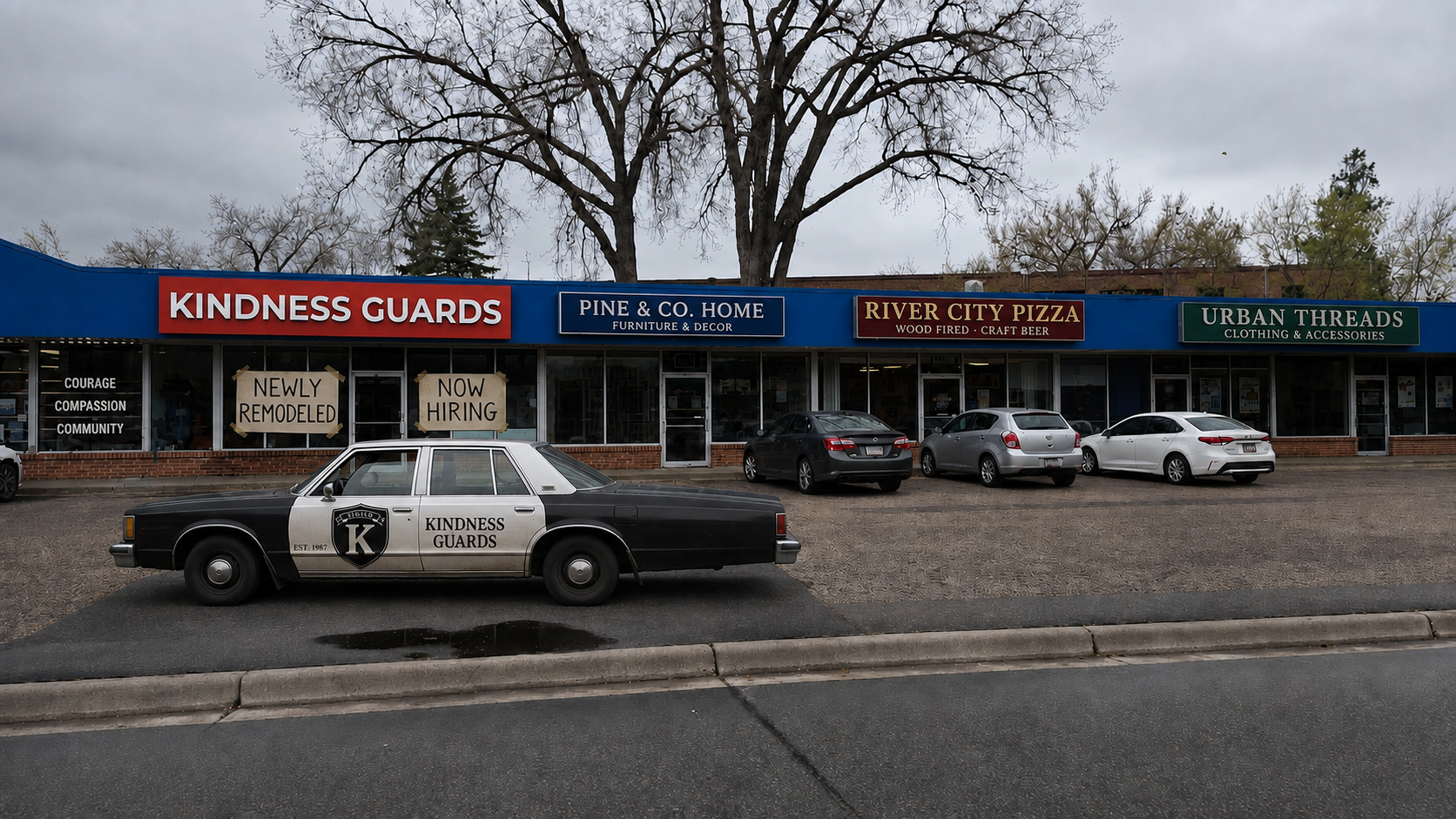
The sign on the window says NOW HIRING. The woman inside says the sign is embarrassing.
“I have been harping on Poppy for weeks,” says Phyllis, who answers the phone at Kindness Guards, a security firm tucked between a Metro by T-Mobile and a nail salon on the boulevard. “Those awful cardboard signs. On a security firm. I said to him — Poppy, if a serious client drives by, they’re going to think we’re a tax preparer.”
Poppy, she clarifies, is her boss. She has worked for him for “a long time now.” She will not say his real name. She will not say how long is long. She will, however, offer a cookie from a Christmas tin on the counter, which the reporter accepts.
This is the first and only interview Kindness Guards has ever given. It was almost certainly not approved.
“I have been harping on Poppy for weeks. Those awful cardboard signs. On a security firm.”
Kindness Guards is the kind of business that most people drive past without noticing. This reporter, admittedly, had done so for years. But a recent jump in signage — the NEWLY REMODELED and NOW HIRING placards that Phyllis finds so objectionable — finally prompted a closer look. What exactly does a security firm called Kindness Guards protect?
The short answer, according to Phyllis, is “acts.”
The long answer is harder to pin down.
A Forty-Year Front Desk
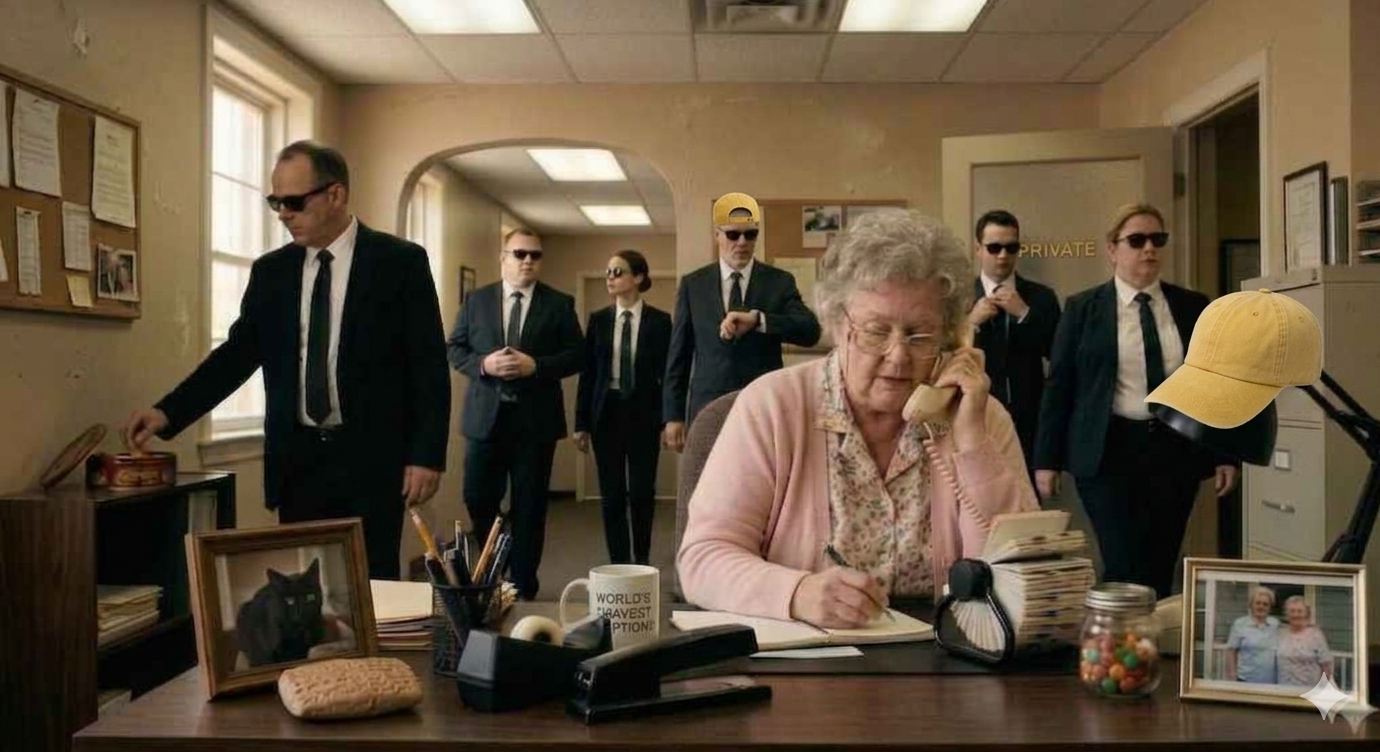
Phyllis’s desk is the kind of workstation that tells you everything about the decade she learned to type in. A beige AT&T touch-tone telephone with a curly cord. A Rolodex she actively uses. A candy dish with ribbon candy that she acknowledges “nobody really eats.” A framed photo of a black cat whose status she declines to clarify. A coffee mug that reads WORLD’S OKAYEST RECEPTIONIST — a gift, she says, from one of the Guards, though she cannot remember which.
Also on the desk: a small ancient-looking clay tablet with faint markings carved into it, sitting casually next to the stapler.
When asked about the tablet, Phyllis looks at it as if noticing it for the first time.
PHYLLIS: “Oh. Yeah. Poppy gave me that one. I don’t really know what to do with it. I don’t want to throw it out because that seems disrespectful. But I can’t spend it. So it just sits there.”
REPORTER: “Can’t spend it where?”
PHYLLIS: “Anywhere, honey. It’s clay.”
The Currency Question
This is where the interview turned strange.
According to Phyllis, the clay tablet on her desk is part of what she calls “the kindness economy.” She does not claim to fully understand it.
PHYLLIS: “You know, overall — I don’t know. I don’t get it. I think if you do a bunch of kind things, they pay you with these tablets. Anyway, all I know is I work a lot of hours here. I got responsibilities. Seems nice and all — and I guess we’re just warming up to those electronic coin things — well, I’m not, but others are — but why clay? Clay breaks. I dropped a cup last week. Now imagine if that was my whole year of kindness.”
REPORTER: “That’s — a fair point, honestly.”
PHYLLIS: “Thank you. Nobody’s thought about it.”
Phyllis says she became concerned enough about the tablets at one point to confront her boss directly.
PHYLLIS: “I went right in to Poppy and I said, ‘You’re not going to start paying me in these, are you?’ Because I have a mortgage. I have a cat. I cannot pay Xcel Energy with a clay tablet, I don’t care how kind it is.”
REPORTER: “What did he say?”
PHYLLIS: “He looked at me for a long time. Then he slid a regular paycheck across the desk. Same as he has for forty years. A real paper check. I walk it across the street to the bank myself every other Friday. I felt much better.”
She adds, almost as an afterthought: “I did hear a rumor somebody down at Premier Bank actually cashed one of these for real. Walked right in with a clay Spark and walked out with — well, I don’t know how much a Spark is worth, honestly. I’m keeping mine just in case.”
The Vault, as Phyllis Understands It
The tablets, Phyllis explains, come from something called “the vault.” When pressed on what the vault is, she takes off her glasses and thinks about it for a long moment.
PHYLLIS: “Oh, the vault. That’s the whole thing. There was a civilization, see — a long time ago, I think it was the Egyptians? Or the Greek ones? I get them mixed up. And they had this whole system where everybody was nice to each other. Not nice like waving at your neighbor — nice like actually going out of your way.”
PHYLLIS: “They wrote it all down on these little clay tablets, and then — I think there was a problem, I’m not totally clear on this part — they put all the tablets in a big vault and sealed it up. Said, ‘We’ll leave this for the next people, in case they forget how to be kind.’ Which is, if you think about it, very thoughtful.”
PHYLLIS: “And then somebody found the vault. I think it was in the nineties? Or maybe last year? Anyway, they opened it up, and now we have all the rules again. There are Sparks, and Flames, and Blazes. I don’t fully understand the currency part. I just know we track who is doing acts of kindness, and the Foundation handles the rest. It’s a lot to explain. You really should look it up — there’s a website.”
When asked who “they” are, Phyllis says: “I don’t know, honey. I really don’t. I’ve never met her. I’m sorry — I mean him. I’m sorry, them. I truly don’t know. Poppy has never said. I don’t ask.”
This reporter did not press.
Business Is Picking Up
Kindness Guards is, according to Phyllis, in a period of growth. The firm has recently signed a long-term contract with something called the AOK World Foundation — which Phyllis describes only as “the people who handle all of that” — and the workload has increased noticeably.
PHYLLIS: “Oh my goodness, yes. Since the AOK World contract came in, things have really picked up. That’s why we’ve got those awful signs in the window. We’re hiring. A lot.”
PHYLLIS: “We had to loosen the standards a little, honestly. Did you know we’re even allowing Guards to have tattoos now? Just not on the neck. Poppy was firm about the neck. I don’t know why. I didn’t ask.”
PHYLLIS: “One young woman came in last week with a whole sleeve — flowers, I think, very pretty — and I thought for sure Poppy was going to say no. But she’s starting Monday. So I guess times change.”
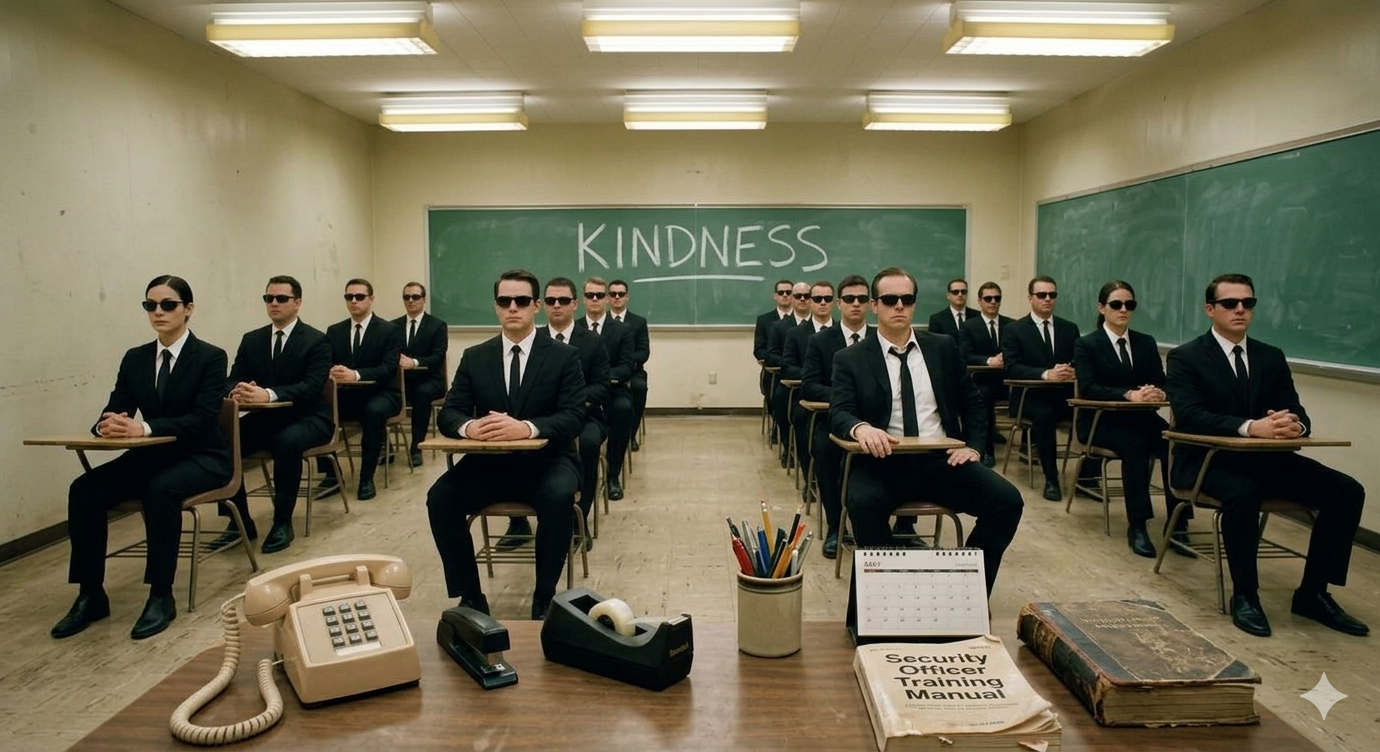
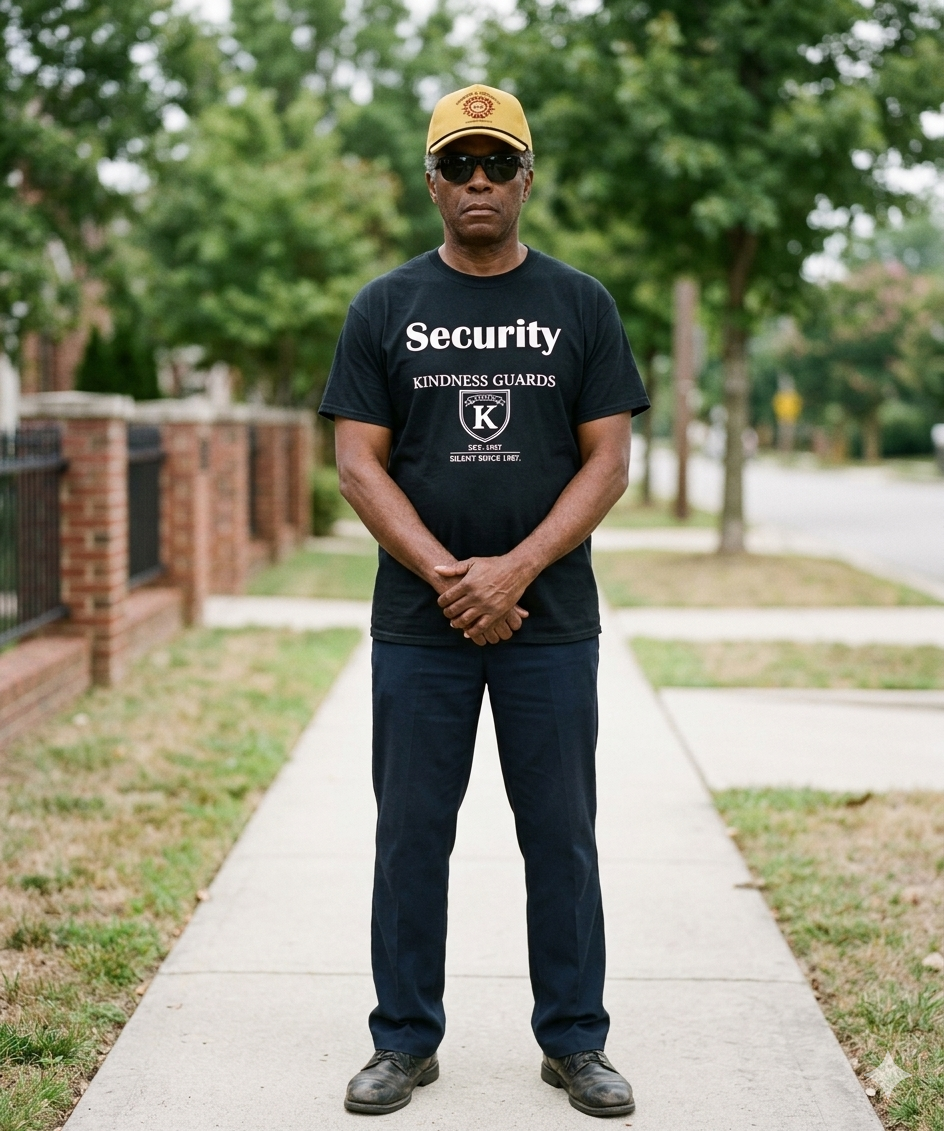
Throughout the interview, several Guards passed through the reception area — all in matching black suits, black ties, and black sunglasses. None spoke. One briefly paused at the cookie tin, took a cookie, and continued on his way. Phyllis did not acknowledge him. He did not acknowledge her. This appeared to be routine.
About the Invoices
Phyllis mentioned, toward the end of the conversation, that she was not personally involved in the Foundation contract negotiations.
PHYLLIS: “No, honey, that was all Poppy. I didn’t see the contract. I don’t know what it says. Poppy signed it. That’s how we do things around here — Poppy signs, I file.”
She paused, then added, with a slight edge in her voice:
PHYLLIS: “But I’ll tell you something. It’s been a couple months now, and we have not seen a payment yet. Not one. I keep typing up the invoices. I give them to Poppy. He tells me he’ll get them to the Foundation. I have to trust he does.”
REPORTER: “And when you ask him about it?”
PHYLLIS: “He gives me the Poppy stare. I can’t always read him with those darn Tom Cruise Pilot Raybans on. But he sure knows how to read me. He knows I’m concerned. He knows I want an answer. He just doesn’t give me one.”
PHYLLIS: “So I keep typing the invoices. I keep handing them to him. Every month. And every month, nothing. But the paychecks still go out on time. Our Guards still get paid. So somebody is paying something, somewhere. I just don’t see it.”
The Kahuna was not available for comment.
On the Photos Behind the Desk
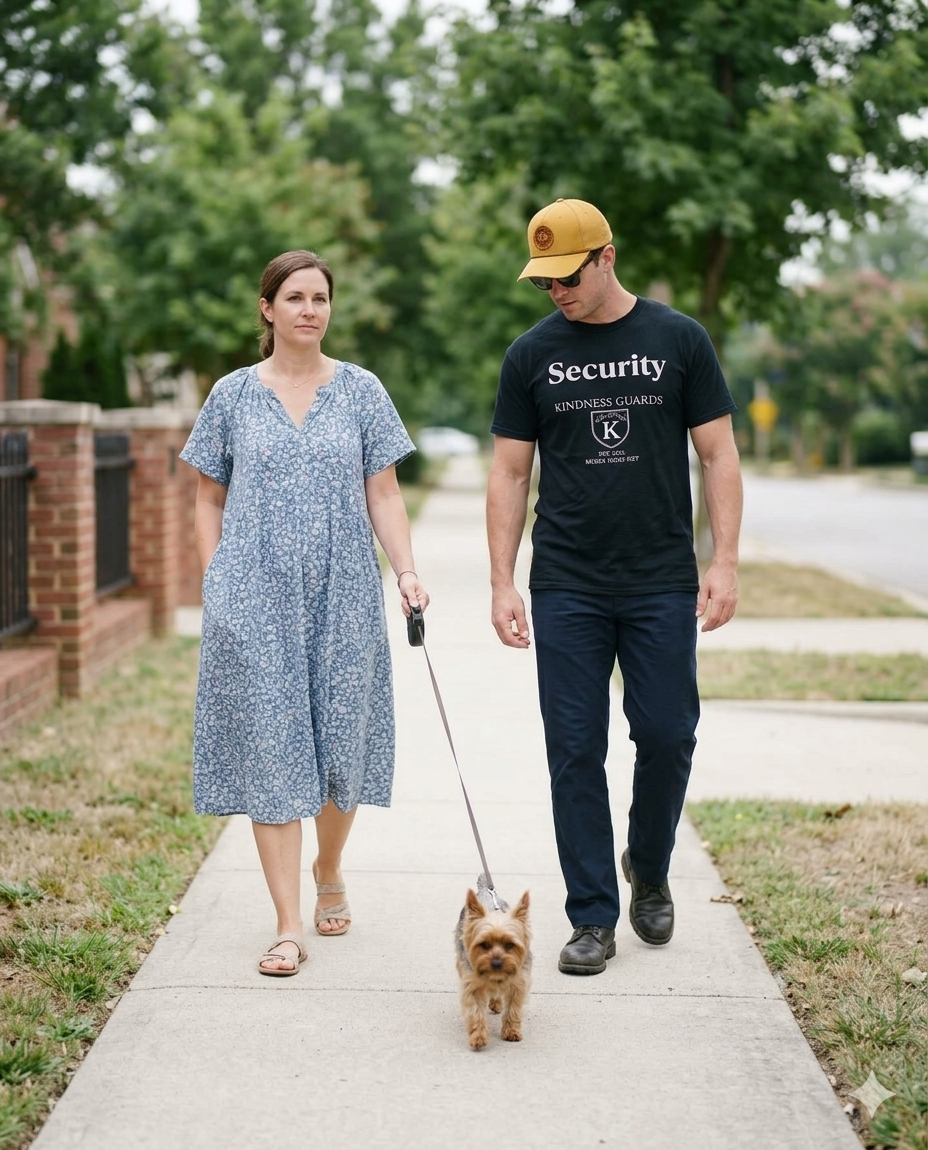
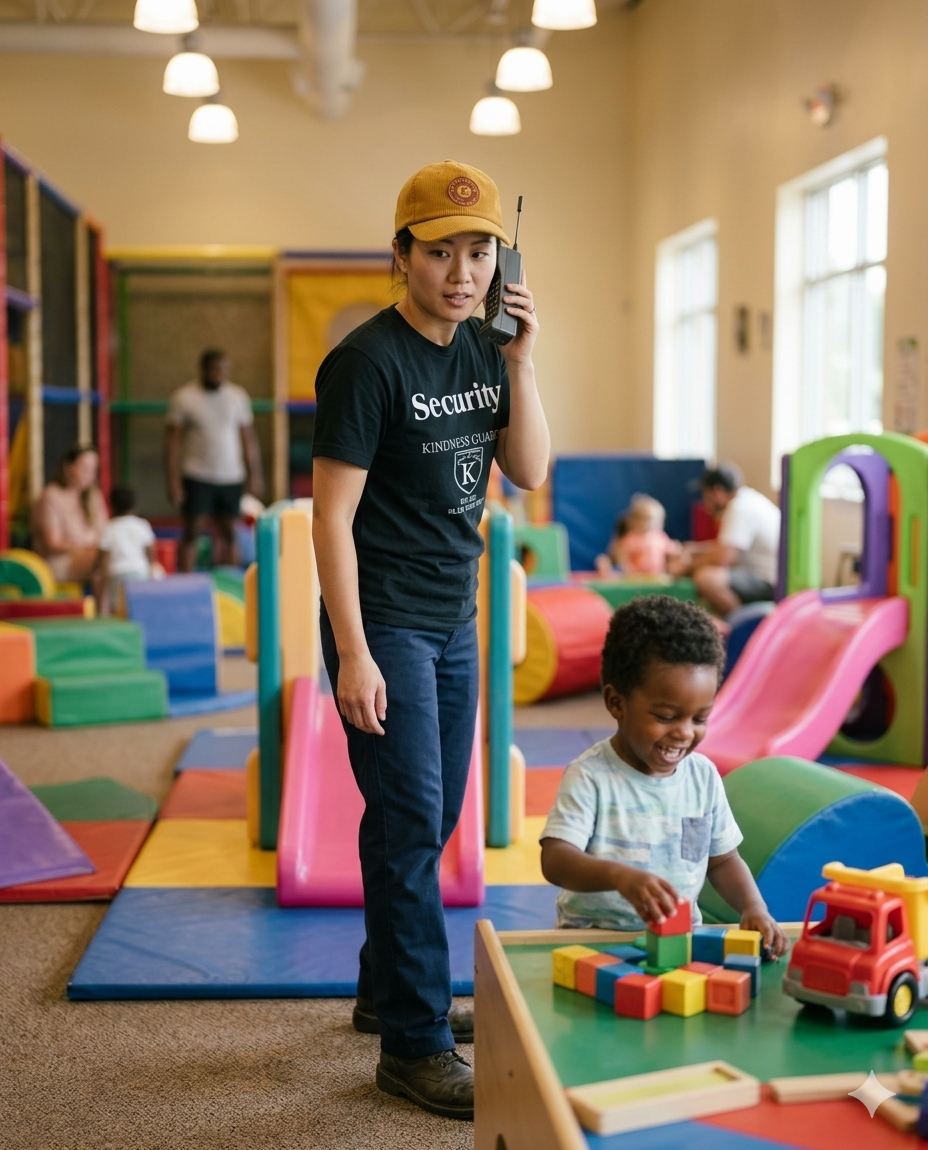
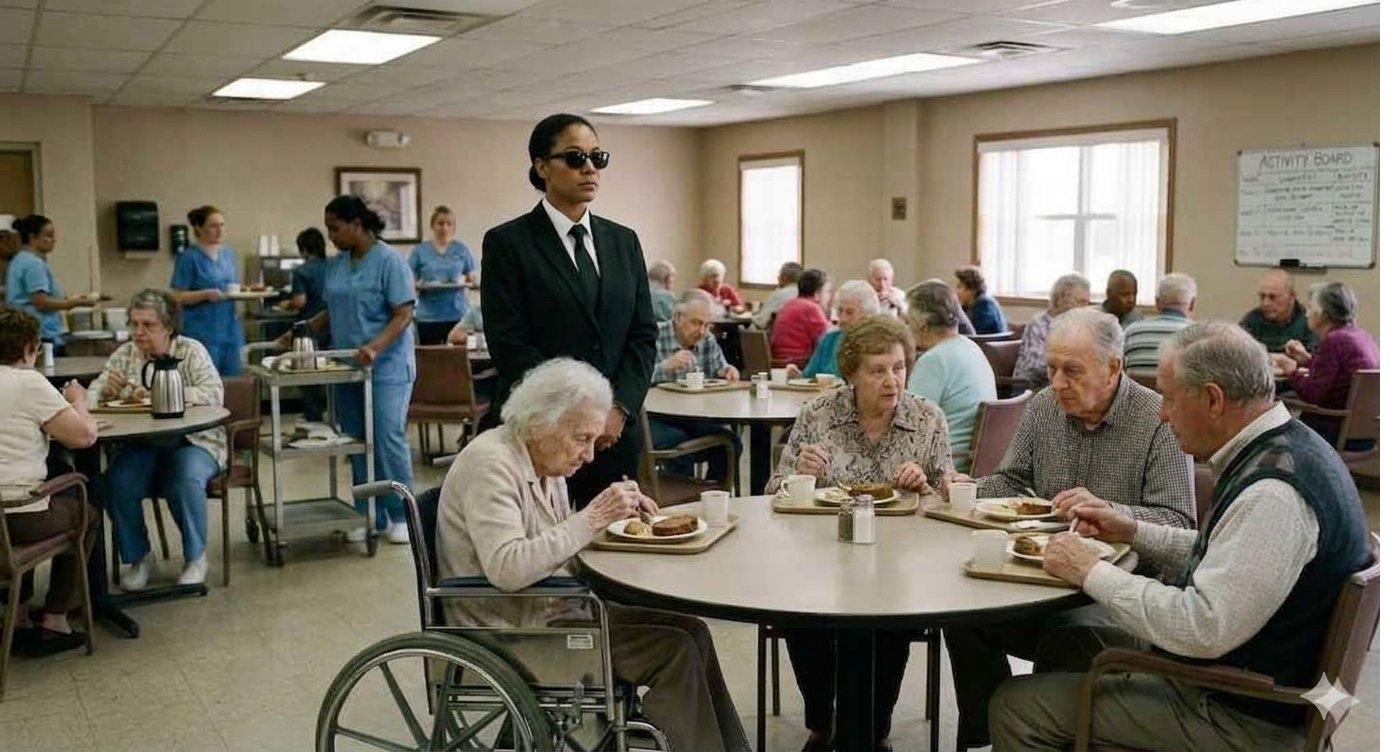
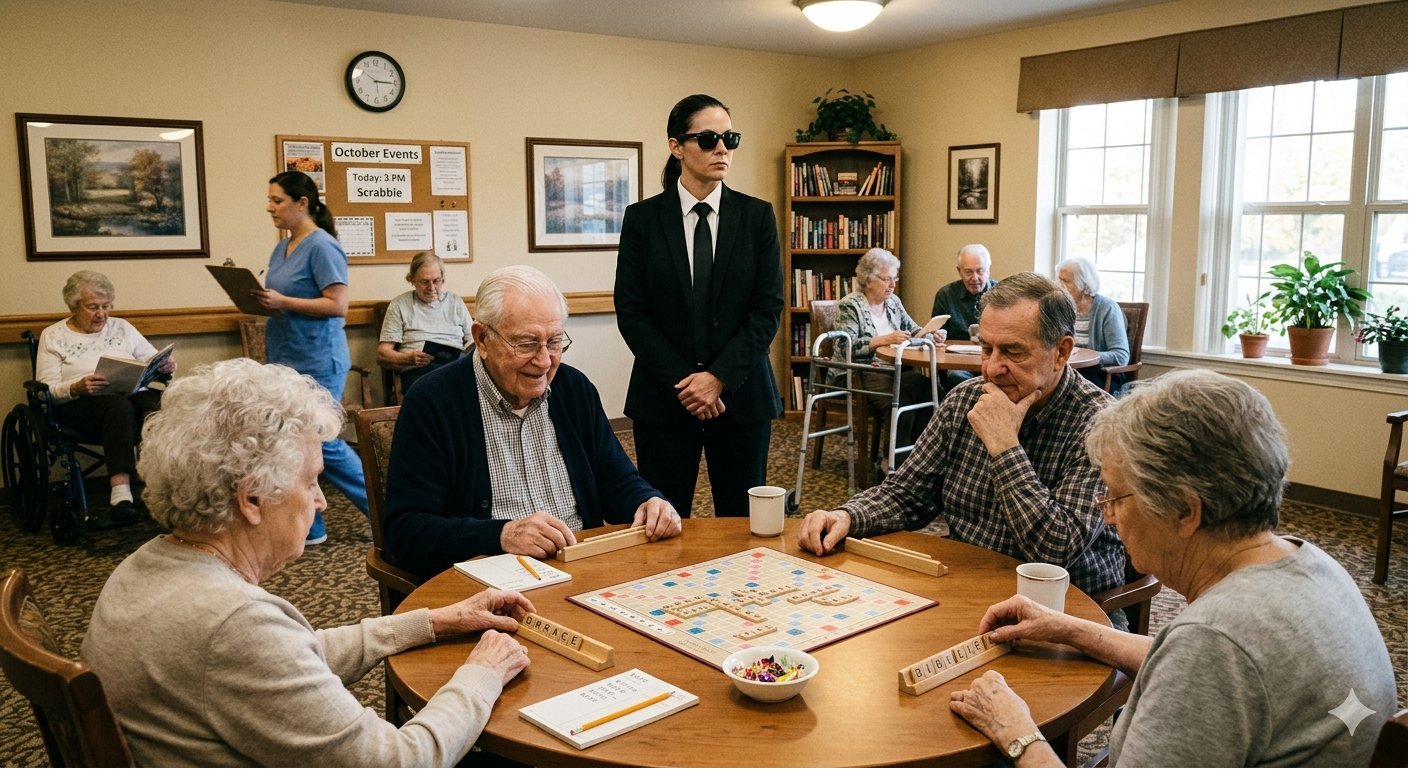
As the interview drew on, this reporter noticed a small collection of framed photographs mounted on the wall behind Phyllis’s desk. Three of them appeared to be candid field shots — a small boy on a playground bench, an elderly woman in a dining hall wheelchair, a suburban sidewalk featuring a small dog on a leash accompanied by what looked like a man in a black suit and sunglasses. None of them were captioned.
When asked what the photos depicted, Phyllis lit up.
PHYLLIS: “Oh, those are some of the boys’ recent assignments. The Foundation likes us to keep a few on the wall. Public relations, I think — not that the public ever sees them. Mostly they make the new hires feel like they’re part of something.”
She stood, walked to the wall, and began pointing.
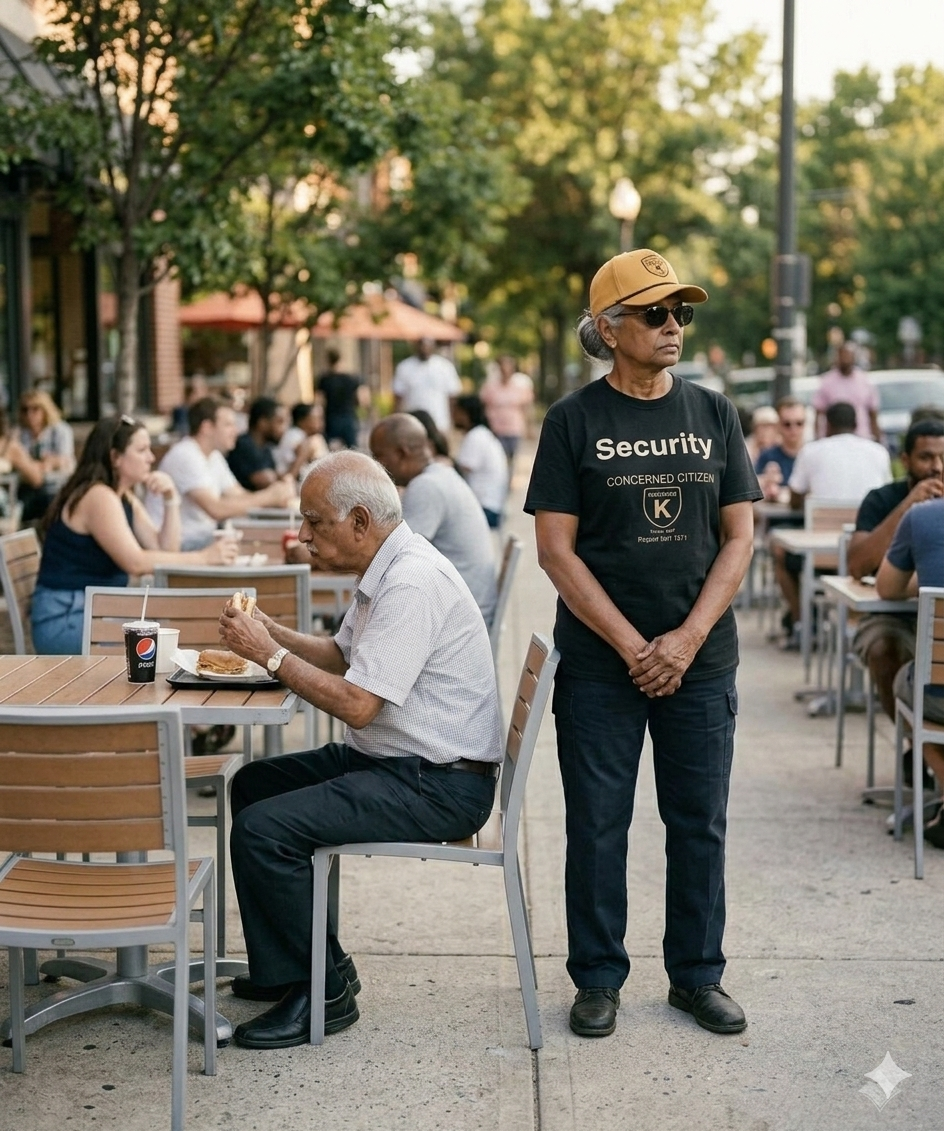
PHYLLIS: “That’s Johnny. Mister Alvarez handles Johnny on Tuesdays and Thursdays. We’ve been on that one about six months now. That’s Mrs. Dellacroix, she’s at Birch Hollow. Miss Patel covers her. And that one is the dog. That’s Muffin. Muffin has a whole Guard assigned to her three afternoons a week. I don’t fully know why. Muffin is a nice dog. Her owner is named Stephanie. That’s as much as I know.”
REPORTER: “A Guard is assigned to a dog?”
PHYLLIS: “Oh my goodness, yes. The Foundation sends the instructions. I schedule the Guards. I don’t always know what’s what. Sometimes we get a note that just says ‘four o’clock, Stephanie’s cul-de-sac, the Yorkie.’ And off goes Mister Henderson. He loves Muffin. Don’t tell him I said that.”
She returned to her chair. Caught her breath. Took a sip of coffee.
PHYLLIS: “You know, times have really changed around here. Oh my goodness. Thirty years ago, this was a completely normal security service. I mean completely normal. We did bank transport details — escorting cash from vaults to the armored cars. We did jewelry store opens and closes. We did weddings — standing by the gift table so nobody wandered off with the silver. Estate sales. The occasional funeral home overnight watch if a family requested it. Normal things. Respectable things. People understood what we did.”
PHYLLIS: “But today — today with this Foundation contract — I am scheduling a Guard to stand silent watch over a Yorkshire Terrier on a cul-de-sac in Minnetonka. I am scheduling a man in a suit to sit next to a nine-year-old boy while he eats a peanut butter sandwich on a bench. I am pulling Miss Patel off her lunch to go stand behind a ninety-year-old woman who is doing nothing except eating meatloaf.”
REPORTER: “Is that a problem?”
PHYLLIS: “Oh, no, honey. If anything, it’s gotten more interesting. Imagine hiring someone to go and protect a Yorkie. Just brings a smile to my face. I’ve been doing this work for forty years, and I’ll tell you, the first thirty-nine were not this interesting. You couldn’t pay me to go back to guarding a jewelry store open at six in the morning when I could be scheduling a Guard for Muffin’s cul-de-sac walk. It’s better. It really is. More confusing. But more fun.”
She looked down at her Rolodex, then up again with a small laugh.
PHYLLIS: “And I haven’t even told you about the yellow one.”
REPORTER: “The yellow one?”
PHYLLIS: “Oh, good Lord. The yellow one. Now, I have never met him in person. But I schedule Guards for him all the time. He’s — well, you’ve seen him, haven’t you? The man in the bright yellow suit running around town doing good deeds? Leaving money in people’s pockets? Buying coffee for strangers? I don’t know his name. I don’t know if anyone does. But I know the Foundation takes him very seriously, because I am sending Guards to follow him around for hours at a time, several times a week, and I have been for months now.”
PHYLLIS: “Can you imagine? A man in a bright yellow suit, doing kind things for strangers, and we have assigned him a silent security detail. I mean — who does that? Who sends a Kindness Guard to follow a man around while he’s busy being kind? It doesn’t make any sense. It brings me so much joy.”
She shook her head, smiling.
PHYLLIS: “You know, some of the boys — the Guards who have worked his details — they come back and they talk about him. Not much. They’re trained good, and most of what they see is private Foundation business. They know not to share. But every now and then one of them will say something. Oh, the things he does. I shouldn’t laugh. But he does some funny things, I’ll tell you. Miss Patel told me one story — I can’t repeat it, of course — and I laughed so hard I had to take my glasses off.”
She paused.
PHYLLIS: “And I’ll tell you something else. I looked him up, on the socials. I don’t really use the socials. But my niece showed me. You can find pictures of him out doing his good deeds. And — well, I’m not the one saying it, you understand — but the comments. Oh, the comments. There are an awful lot of people on there who seem to think he’s quite a handsome man. I’m just saying what I read. That’s what they’re saying. It’s not me.”
A small pause. She adjusted her glasses.
PHYLLIS: “I mean, he does have very good posture. That I can say. You can tell from the photos. Good posture is rare in a man these days.”
She cleared her throat and returned to her Rolodex. Then, almost immediately, looked up again.
PHYLLIS: “Oh — and I heard he has a cat.”
REPORTER: “AOK Man?”
PHYLLIS: “Yes. A gold tabby. His name is Nugget. Mister Alvarez mentioned it offhand one day — said he’d seen the cat when he was on a detail, through a window or something. A gold cat named Nugget. I don’t know how to explain this to you, honey, but that changes everything for me.”
She gestured to the framed photo on the edge of her desk — a sleek black cat, imperious, staring directly at the camera with unmistakable judgment.
PHYLLIS: “That’s Mister Purrz. That’s spelled P-U-R-R-Z, by the way. With a Z. It looked cute in ninety-eight and now it’s too late to change it. Rescue. I got him when he was a kitten. He is my best friend. Don’t tell Poppy. But he is.”
She looked back at the reporter.
PHYLLIS: “I’ll tell you what I know about people, having lived a long time. A man with a cat is a man I can trust. I don’t care what else he does or doesn’t do. I don’t care if he’s running down the street in a bright yellow suit handing out twenty-dollar bills to strangers. A man who has gone out of his way to make a home for an animal — who has taken on the responsibility of feeding something, and cleaning up after something, and sitting on the couch at night with something that’s purring next to him — that is a man with a soul I recognize. That man is not dangerous. That man is not cold. That man is good.”
She nodded once, firmly.
PHYLLIS: “So whatever he’s doing out there, I’m on his side. I was already leaning that way. But now I know. A gold cat named Nugget. How bad can he be? He can’t. That’s how bad. He can’t.”
She picked up her coffee, seemed to remember it was cold, and put it down again.
PHYLLIS: “I sure would like to sit down and talk to him someday. Just to ask him what he’s thinking. Where does a person get the idea? How does he pick who to give the money to? I don’t know anything about him. But I schedule his Guards, and I read the paperwork, and I hear the stories the boys bring back. And I think — that man right there is doing something good. And I don’t know what it is. And I don’t need to.”
She took a sip of coffee, forgetting again that it was cold.
PHYLLIS: “I’m guessing I’ll get my chance one of these days. Poppy knows him. He has to. Eventually he’ll walk through that door, and I’ll offer him a cookie, and we’ll finally meet. I’d like that. Mister Purrz would like him. I’m certain of it.”
A pause.
PHYLLIS: “And I hope he likes oatmeal raisin. That’s what I’m making this week.”
On Reading the Constitution
Near the end of the interview, Phyllis mentioned, almost shyly, that she has been reading what she calls “the constitution” — a document associated with the AOK World Foundation.
PHYLLIS: “I read a little bit of it every afternoon when things slow down. I’m on Article Three. It’s beautiful, what they wrote. I don’t understand all of it. But I’m trying. Poppy says I don’t have to. But I want to.”
Asked why she wanted to, Phyllis paused. She adjusted her glasses. Then she said:
PHYLLIS: “Because he cares about it. And he has worked very hard. And I have worked for him for a long time. And if this is what the work is now — then I want to know what it says. That’s all.”
She then answered the phone, which had been ringing for about ten seconds, apologized for the interruption, and spent the next four minutes warmly confirming a Guard deployment with a caller she referred to only as “Mister James.”
Before I Left
As I gathered my notes, Phyllis pressed a small Tupperware container of homemade cookies into my hands and thanked me again for coming.
PHYLLIS: “I’m sure glad you called us for this interview. I was really harping on Poppy about those signs. Maybe now he’ll do something about it. A real newspaper article — with a real reporter — that might finally get through to him. So thank you. Really.”
I mentioned, as I packed up, that the Kindness Gazette — the Foundation’s paper of record — had been asking me about her. They wanted to run a regular column. Something from her desk. They had a title in mind.
REPORTER: “They said they’d call it ‘Just Around the Corner with Phyllis.’ I told them I’d pass it along.”
PHYLLIS: “A column. For me. Oh my goodness.”
A longer pause.
PHYLLIS: “I’ll have to think about it.”
Another pause.
PHYLLIS: “I’ve been thinking about it.”
I asked if there was anything else she wanted the readers of The TC Highlighter to know about Kindness Guards.
She thought about it for a moment.
PHYLLIS: “We’re good people here. We really are. I don’t always understand everything. But I know that. Tell them that.”
Kindness Guards is located on the boulevard, between a Metro by T-Mobile and Magic Nails. Their website, according to Phyllis, is “the one with our name on it — I’ve looked at it once, it’s a little dark, but it’s there.”
The signs, as of press time, remain in the window.